
Sedation Options at the Dentist: What Each One Feels Like and Who Needs Which
Dental offices commonly offer three levels of sedation: nitrous oxide, oral sedation, and intravenous sedation. In all three, you stay awake, you breathe on your own, and you can respond when spoken to. None of them is a general anesthetic. We decide which one you need based on two things: how anxious you are, and how long and invasive the procedure is.
Nitrous oxide suits mild nerves and shorter appointments, and it wears off in minutes. Oral sedation suits moderate anxiety and leaves most people with patchy or no memory of the visit. Intravenous sedation suits severe anxiety, long surgical appointments, or anyone who has tried the lighter options without success, and it produces the deepest relaxation available outside a hospital. General anesthesia, where you are fully unconscious, is a separate category that a general dental practice rarely provides.
This article explains what each level feels like from the chair, how long recovery takes, what the safety screening involves, and what Ontario rules require of any office that offers it. It also includes a full section for parents on how sedation works for children.
Key Takeaways
- Nitrous oxide, oral sedation and IV sedation all leave you conscious. You can hear the team, answer questions and move if asked. The difference is how relaxed you feel and how much you remember afterward.
- Recovery time is the practical difference. Nitrous clears within minutes, and you can usually drive yourself home. Oral and IV sedation require someone to take you home and most of the day off.
- Sedation is not only for anxiety. A strong gag reflex, a long surgical appointment, difficulty getting numb, or a medical condition that makes sitting still hard are all common reasons.
- Ontario regulates this tightly. Dentists need current sedation authorization and, for anything beyond minimal sedation, the office needs a facility permit granted after an on-site inspection.
- For children, nitrous oxide is the standard starting point. Deeper sedation for a child is a different decision with different requirements, and sometimes the right answer is a hospital rather than a dental office.
- You can verify the credentials yourself. The regulator publishes a public register showing whether a dentist holds current sedation authorization.
Find our Dental Clinic Near You
Sedation Is Not Only for Anxious Patients
The common assumption is that sedation exists for people who are frightened of the dentist. Fear is the most common reason, but it is not the only one, and many patients who would benefit never ask because they do not think it matters.
Who Sedation Is Actually For
- People with dental anxiety or dental phobia. This ranges from mild unease to an avoidance so complete that someone has not been examined in a decade.
- People with a strong gag reflex. If impressions, X-rays, or work on the back teeth trigger gagging, sedation reduces the reflex enough to make treatment possible.
- Anyone facing a long appointment. Two or three hours in a chair is tiring regardless of nerves. Sedation makes a long surgical visit feel shorter.
- People who are difficult to freeze. Some patients metabolize local anesthetic quickly or have anatomy that makes a reliable block harder. Sedation raises the pain threshold and reduces anxiety, making freezing feel less effective.
- People who cannot comfortably stay still. Movement disorders, chronic pain, severe back problems and some developmental conditions all make a long appointment genuinely difficult.
- Anyone with a bad past experience. A single painful or rushed appointment years ago can shape every visit since.
Signs Sedation Would Change Your Experience
If you recognize more than one of these, it is worth raising at your next visit rather than pushing through:
- You reschedule or cancel dental appointments more than once before you attend.
- You sleep the night badly before an appointment.
- You have delayed treatment you know you need for more than a year.
- You feel your heart rate rise in the waiting room.
- You have avoided treatment entirely and are now dealing with the consequences.
The Levels of Sedation, from Lightest to Deepest
Ontario regulates these as distinct levels with different training and facility requirements attached to each. Understanding the ladder helps you have a sensible conversation about which rung you actually need.
Nitrous Oxide, or Laughing Gas
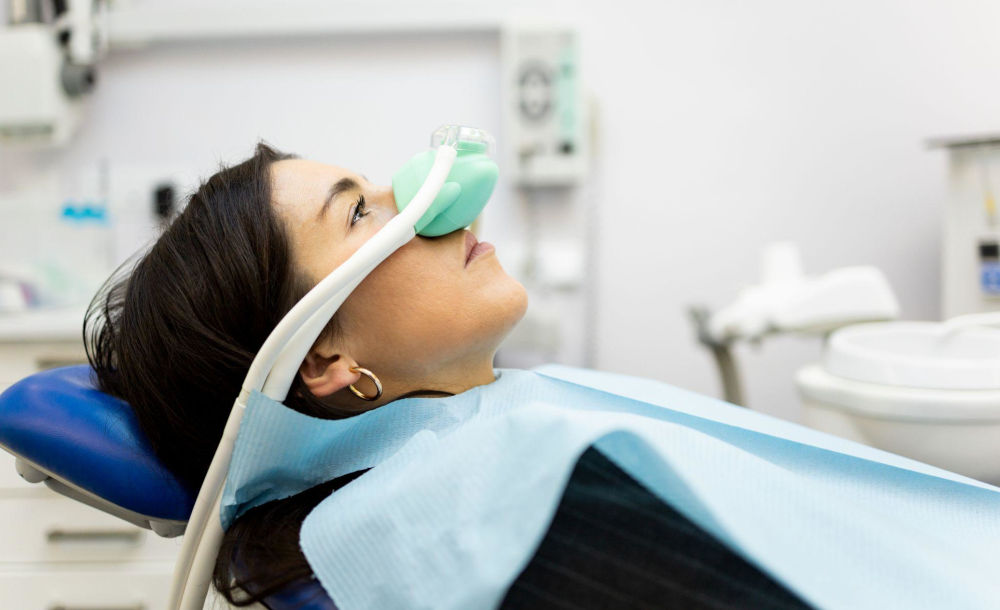
Nitrous oxide is a gas breathed through a small mask that sits over the nose. It is mixed with oxygen and the concentration is adjusted throughout the appointment. It takes effect in about three to five minutes.
What it feels like: a light, floating warmth, often with tingling in the hands or feet. Sounds may seem slightly distant. You are fully aware of where you are and what is happening, and you can talk normally. Most people describe it as taking the edge off rather than removing awareness.
When the procedure finishes, the nitrous is switched off, and you breathe pure oxygen for several minutes. The effect clears almost completely within about five to ten minutes, which is why nitrous is the only level of sedation after which most patients can drive themselves home.
Under the Ontario Standard of Practice , nitrous oxide combined with oxygen is classified as minimal sedation. Combining a nitrous mask with an oral sedative, however, is not minimal sedation at all. Any such combination is treated as oral moderate sedation regardless of dose, and triggers the full authorization and facility permit requirements.
Oral Sedation
Oral sedation means taking a prescribed tablet, usually from the benzodiazepine family, before the appointment. Depending on the drug, that may be an hour beforehand or the night before and again on the morning of.
What it feels like: heavy and drowsy. Many patients doze and are woken easily. Speech may slow. The characteristic feature is partial amnesia: people often remember arriving and remember leaving, with very little in between. That gap is a feature rather than a side effect, and it is why oral sedation suits patients whose anxiety is rooted in the memory of previous visits.
Because you swallow the dose rather than titrating it, you can't adjust the depth once it has taken effect. You must be driven home, and you should not work, sign documents or supervise children for the rest of the day.
Intravenous Sedation
IV sedation delivers medication directly into a vein through a small cannula, usually in the arm or hand. This is what people generally mean by twilight sedation or conscious sedation.
What it feels like: the onset is quick, within a minute or two, and most patients remember very little afterward. You can still breathe on your own and respond to instructions, but the relaxation is deeper than anything achievable by mouth. Patients frequently report that the appointment seemed to last a few minutes.
The clinical advantage is control. Because the medication is given through a line, the dentist can adjust the depth during the procedure rather than committing to a dose at the start. That makes IV sedation the appropriate choice for long surgical appointments and for patients whose anxiety has not responded to lighter options.
IV sedation requires continuous monitoring of oxygen levels, heart rate and blood pressure, a trained assistant dedicated to that monitoring, and a recovery period in the office before you are released to the person taking you home.
General Anesthesia, and Why It Usually Is Not a Dental Office Procedure
General anesthesia means full unconsciousness with no response to stimulation. It falls into a different regulatory category than the three levels above and requires either a hospital setting or a dental facility with a permit specifically for it, with an appropriately qualified provider present.
Most general dental practices do not offer it, and most patients who assume they need it actually need IV sedation, which produces a very similar subjective experience with substantially lower risk. If you are told general anesthesia is genuinely necessary, that usually signals that a hospital or specialist referral is the right route.
| Nitrous oxide | Oral sedation | IV sedation | |
|---|---|---|---|
| How it is given | Inhaled through a nose mask | Tablet taken beforehand | Through a cannula in a vein |
| Time to take effect | 3 to 5 minutes | 30 to 60 minutes | 1 to 2 minutes |
| Awareness | Fully aware | Drowsy, easily roused | Deeply relaxed, still responsive |
| Memory of the visit | Full | Patchy or absent | Usually absent |
| Depth adjustable during treatment | Yes | No | Yes |
| Recovery | 5 to 10 minutes | Rest of the day | Rest of the day |
| Escort needed | Usually not | Yes | Yes |
"Patients ask me which one is strongest, but that is rarely the useful question. The useful question is what we are treating and how long you will be in the chair. A nervous patient having one filling and a nervous patient having four implants placed need completely different approaches, even though the anxiety is identical. Matching the level to the appointment is most of the work." — Dr. Amir Guorgui, BSc, DMD, MACSD, Pickering Smile Centre
What Sedation Actually Feels Like
The experience can also vary based on the medication, how quickly it takes effect, and how your body responds. Some people notice changes in their sense of time or feel deeply relaxed, while others stay aware of what is happening but feel less concerned.
Will I Be Unconscious?
No, not with any of the three office-based levels. Unconsciousness is the defining feature of general anesthesia and is not the goal of sedation. With IV sedation in particular, patients often insist afterward that they were asleep, because they have no memory of the appointment. The distinction matters clinically: you breathe independently and respond to instructions throughout.
Will I Remember Anything?
With nitrous oxide, yes, you will remember the appointment normally. With oral sedation, most people retain fragments. With IV sedation, most people remember nothing between the cannula being placed and waking up in recovery. If the memory of previous appointments is the source of your anxiety, that is the single most useful thing sedation offers.
How Long Until I Feel Normal Again?
Nitrous oxide clears within five to ten minutes after the gas is turned off, with a few minutes of pure oxygen. Oral and IV sedation both require the rest of the day. You will feel functional within a few hours, but judgment and coordination take longer to return than they feel like they have. Plan nothing for that day, and expect to sleep well that night.
Does It Replace Freezing?
No, and this surprises people. Local anesthetic is still given with every level of sedation. Sedation manages anxiety and awareness; the local anesthetic manages pain. Under IV sedation, you will not remember the injection, which is often the part patients dread most, but the injection still happens.
Matching the Sedation Level to the Procedure
As a general guide, the required depth increases with the length and invasiveness of the appointment. This is a starting point for the conversation, not a rule, because the patient's anxiety level moves everything up or down a rung.
| Procedure | Typical level | Why |
|---|---|---|
| Cleaning or examination | None, or nitrous for anxious patients | Short and non-surgical |
| Single filling | None, or nitrous | Short; local anesthetic is sufficient for most |
| Root canal treatment | Nitrous or oral | Longer appointment, high anxiety association |
| Simple extraction | Nitrous or oral | Short but psychologically difficult for many |
| Wisdom teeth removal | Oral or IV | Surgical, often multiple teeth in one visit |
| Single implant placement | Nitrous or IV | Surgical but usually brief |
| Multiple implants or full arch treatment | IV | Long surgical appointment, depth control needed |
| Extensive treatment consolidated into one visit | IV | Reduces the number of appointments required |
For patients considering wisdom teeth removal or other dental surgery , the sedation discussion usually happens at the consultation, once the scans show how complex the case is.
Sedation for Children: What Parents Need to Know
If a dentist has suggested sedation for your child, the reaction is almost always the same: a pause, then the question of whether it is really necessary and whether it is safe. Both are reasonable questions, and both have clear answers. This section is written to be read on its own.
Why a Child Might Need Sedation at All
Sedation for a child is not about a badly behaved patient. The clinical reasons are specific:
- The amount of treatment needed. A child with several cavities may need four or five separate appointments without sedation, or one with it. For a young child, the second option is frequently kinder.
- Age and ability to cooperate. A four-year-old cannot reliably stay still with an instrument in their mouth for forty minutes. That is developmental, not behavioural.
- Safety during the procedure. Sudden movement while a drill or a sharp instrument is in the mouth is a genuine injury risk. If a child cannot stay still, some procedures cannot be performed safely.
- Previous distressing experience. A child who has already had a frightening appointment may be unable to sit through another one, and forcing it tends to entrench the fear for life.
- Dental trauma. A knocked-out or broken tooth after a fall involves an upset child and time-sensitive treatment, a combination that often needs help.
- Special needs. Sensory sensitivities, developmental conditions and movement disorders can make an ordinary appointment genuinely impossible.
What Is Used for Children, and What Is Not
Nitrous oxide is the standard starting point in general dental practice, and for most children it is the only thing required. Ontario classifies it as minimal sedation; it is adjustable moment to moment, and it leaves the child awake and talking throughout.
Oral sedation is used for children more selectively. It is not adjustable once given, and children vary considerably in how they respond to a given dose, so it is a bigger clinical decision than it sounds.
Deep sedation and general anesthesia for children are a different category entirely. They require a facility permit specific to that level, granted only after an on-site inspection, and an appropriately qualified provider. Many cases at that level are appropriately referred to a hospital rather than performed in a dental office. If your child genuinely needs this level of care, a referral shows good judgment rather than a limitation.
Ask which of these is being proposed for your child, by name. The answer should be one specific modality, not a general reassurance.
Nitrous Oxide for a Child, Step by Step
Knowing the sequence in advance makes it much easier to explain to your child and makes the day less unsettling for both of you.
- A small soft mask is placed over the nose only. The mouth stays free. Many practices let the child choose a scent.
- The child breathes normally through the nose. Nothing is forced, and nothing hurts. This is the whole of the procedure from the child's point of view.
- Within three to five minutes, the child usually becomes visibly calmer, sometimes giggly, sometimes just still. They can hear you and answer you the entire time.
- The dentist adjusts the concentration during treatment, increasing it for the harder moments and lowering it afterward.
- The dentist still gives local anesthetic when the treatment requires it. Nitrous calms the child; it does not numb the tooth.
- At the end, the nitrous is switched off, and the child breathes pure oxygen for several minutes.
- Most children are back to normal within about ten minutes and can go to school or daycare the same day.
Is It Safe? What the Rules in Ontario Actually Require
Nitrous oxide has been used in dentistry for well over a century and is the most extensively used form of pediatric dental sedation. That does not make it risk-free; the honest framing is that it is well established and tightly regulated, not simply safe. In Ontario, every dentist who administers sedation must hold current authorization from the regulator , and that authorization has to be renewed annually. Any level beyond minimal sedation also requires the office to hold a facility permit, granted only after reviewing the dentist's training and conducting an on-site inspection of the premises and emergency equipment.
Two things follow from that, and both are useful to a parent. First, the requirements are specific and enforced, not aspirational. Second, you can check them yourself: the regulator maintains a public register that shows whether a given dentist holds current sedation authorization. You don't need to take anyone's word for it.
The Risks, Stated Plainly
The most common side effect of nitrous oxide in children is nausea, and occasionally vomiting, which is why an empty or very light stomach is usually advised. Some children feel briefly dizzy or unsettled as it takes effect or wears off. A small minority become agitated rather than calm, which is why the concentration is adjusted rather than set and left.
Nitrous oxide is delivered through the nose, so a child with a blocked nose, a heavy cold, enlarged adenoids or a habit of mouth breathing may not get enough of it for it to work. Mention any of these when you book, because it changes the plan. Certain medical conditions also make nitrous unsuitable, which is what the medical history review is for.
How to Prepare Your Child on the Day
- Follow the eating instructions exactly. They differ by sedation type. For nitrous, a light meal is usually fine. For anything deeper, you will be given specific fasting times, and they are not negotiable.
- Bring the full medication list, including inhalers, supplements and anything over the counter.
- Dress them in short sleeves and something comfortable, and bring a familiar toy or blanket.
- Use plain, neutral language. Words like hurt, needle, pain, drill and shot put an idea in a child's head that was not there before. Sleepy air, a tooth pillow and counting teeth are the kind of phrasing dental teams use for a reason.
- Do not promise there will be no discomfort. If your child later feels pressure and you told them they would feel nothing, you lose their trust for every future appointment. Better to say that the team will help them and that you will be nearby.
- Keep your own tone flat and ordinary. Children read parental anxiety immediately and accurately. A calm parent is one of the most effective interventions available.
What You Will See Afterward
After nitrous oxide, most children are themselves again within ten minutes and behave normally for the rest of the day. After oral or deeper sedation, expect several hours of drowsiness, some unsteadiness on their feet, and occasionally irritability or tearfulness as it wears off. That is ordinary and not a sign that something has gone wrong.
Offer fluids first and food only once they are fully alert. Keep the day quiet and skip sports, cycling and playground equipment. Call the office if your child is unusually difficult to rouse, is vomiting repeatedly, or if the numbness leads to them chewing their lip or cheek, which young children do without noticing.
When a Dental Office Is Not the Right Setting
Some situations belong in a hospital, and a dentist who says so is doing the right thing. That includes very young children needing extensive treatment, children with significant medical complexity such as cardiac or airway conditions, cases where the treatment required is simply too long for office sedation, and children for whom lighter approaches have already failed.
In these circumstances, a referral is not a failure or a sales tactic. It is the same judgment you would want from any clinician about the limits of their setting.
Questions Worth Asking Before You Agree
A dental team that is comfortable with what it offers will answer all of these without hesitation:
- Which specific type of sedation are you recommending, and why that one rather than a lighter option?
- Do you hold current sedation authorization, and does this office hold a facility permit for this level?
- Who will monitor my child during the procedure, and what will be monitored?
- What happens if my child does not settle or reacts badly?
- Can I stay in the room, and if not, why not?
- What are the eating and drinking instructions, and by what time?
- What should I watch for at home, and what number do I call if I am worried?
"The part parents underestimate is how much the appointment is shaped before anyone sits down. A child told they are going somewhere scary arrives already braced. A child told they are going to have their teeth counted arrives curious. I would rather spend ten minutes on the phone beforehand talking a parent through what to say than spend forty minutes trying to recover an appointment that started badly." — Dr. Christian Samuel, General Dentist, Pickering Smile Centre
Safety Screening: What Happens Before You Are Sedated
The screening isn't a formality, and the questions aren't padding. Each one changes something about how sedation is planned.
The Medical History Review
Expect detailed questions about heart and lung conditions, sleep apnoea, liver and kidney function, pregnancy, allergies, and every medication you take, including supplements and anything bought over the counter. Sedatives interact with a long list of common drugs, and several ordinary conditions change the safe dose considerably. Answer completely, including anything you take occasionally.
Fasting and Medication Instructions
For nitrous oxide, a light meal beforehand is usually fine, and an empty stomach is often discouraged. For oral and IV sedation, you will be given specific fasting times for food and for clear fluids, and they exist to protect your airway. If you eat when you were asked not to, say so rather than proceeding, because the appointment will be rescheduled either way and the honest version is far safer.
Monitoring During the Appointment
For moderate sedation, monitoring is continuous rather than occasional: oxygen saturation, heart rate and rhythm, and blood pressure, with a trained team member whose role is to watch them. The office must also keep specific emergency equipment and drugs, and regulators check these during on-site inspections rather than relying on self-certification.
Why You Need Someone to Drive You Home
After oral or IV sedation, you cannot legally or safely drive, and this is not negotiable. The person collecting you needs to be an adult who can stay with you for several hours. Judgment returns more slowly than alertness, so decisions, contracts, and childcare should wait until the next day.
What Sedation Costs and Whether Insurance Covers It
Sedation is charged separately from the dental treatment itself, and in Ontario it is usually billed by time rather than as a flat fee. That means the cost scales with the length of the appointment, and longer procedures carry a proportionally larger sedation fee.
The three levels are priced very differently. Nitrous oxide is the least expensive by a wide margin. Oral sedation adds the cost of the prescription and the additional monitoring. IV sedation is the most expensive, reflecting the drugs, the equipment, the monitoring and the dedicated staff member required throughout.
Insurance coverage is inconsistent, so check before you book. Many plans cover sedation when there is a documented medical or clinical indication, such as a surgical procedure or a condition that prevents treatment otherwise, and decline it when the only stated reason is anxiety. A predetermination, where you send the proposed treatment to your insurer in advance, removes the guesswork. Where coverage falls short, a payment option can spread the cost.
Sedation at Pickering Smile Centre
The clinic offers the full range of office-based options: nitrous oxide, oral sedation and intravenous sedation. This lets the sedation approach match the patient and the procedure, rather than limiting treatment to a single option. Our sedation and sleep dentistry services cover these options in more detail, including how each level works and what patients can expect before and after treatment.
Dr. Amir Guorgui holds a Master's from the College of Sedation and Fellowship status with the International Congress of Oral Implantologists, a combination that allows complex implant surgery and deeper sedation to be delivered in the same visit rather than split across providers.
The practical consequence for a patient is fewer appointments. Treatment that would otherwise be spread over several visits can frequently be consolidated into one sedated appointment, which matters most for the patients who find attending difficult in the first place.
Sedation Turns an Appointment You Keep Postponing into One You Can Actually Book
Most people who would benefit from sedation never raise it, either because they assume it is reserved for extreme cases or because they are embarrassed to admit how much they dread the chair. Neither is a good reason to keep delaying treatment that is quietly getting more complicated.
The decision itself is not complicated. Dental offices offer three levels; all three leave you awake and breathing on your own, and the right one depends on your anxiety level and how long the appointment will be. Nitrous for light nerves and short visits, oral for moderate anxiety, intravenous for severe anxiety or long surgery. General anesthesia is a different category and rarely the answer.
For children, the same logic applies on a smaller scale, with nitrous oxide as the standard starting point and deeper options treated as a separate, more considered decision. Parents are entitled to ask exactly which modality is proposed, what permits the office holds, and who is monitoring their child, and to verify the answers on the public register.
The conversation costs nothing and takes about fifteen minutes. If dental anxiety has been the reason you have postponed treatment, say so when you call rather than when you arrive, so we can build the appointment around it from the start. Book a consultation and mention that you would like to discuss sedation options.
Frequently Asked Questions
Will I be asleep during dental sedation?
Not with any of the three office-based levels. Nitrous oxide, oral sedation and IV sedation all leave you conscious and breathing on your own. Many patients under IV sedation believe they were asleep because they remember nothing, but they were responsive throughout. Full unconsciousness is general anesthesia, a separate category rarely performed in a general dental office.
Is nitrous oxide safe for children?
Nitrous oxide is the most widely used form of sedation for children in dentistry and has a long record of use, but it is regulated rather than simply assumed to be safe. In Ontario, the dentist must hold current sedation authorization, renewed annually. The most common side effect is nausea. It is delivered through the nose, so a blocked nose or heavy cold can prevent it from working, and some medical conditions make it unsuitable, which is what the medical history review identifies.
How long does it take to recover from IV sedation?
You will spend time in the office recovering before being released to the person taking you home, and you should plan to rest for the rest of the day. Most people feel functional within a few hours, but coordination and judgment return more slowly than alertness does. Avoid driving, work, legal documents and sole responsibility for children until the following day.
Can I drive myself home?
After nitrous oxide, usually yes, since the effect clears within five to ten minutes of breathing pure oxygen. After oral or IV sedation, no. You need an adult to drive you and to remain with you for several hours afterward. This is a safety requirement, not a suggestion, and we cancel appointments when no escort is available.
Does dental insurance cover sedation?
It varies considerably by plan. Coverage is more likely when there is a documented clinical indication, such as a surgical procedure, and less likely when anxiety is the only stated reason. Sedation is generally billed by time rather than as a flat fee, so the amount depends on the appointment length. Send a predetermination to your insurer before booking if you want the figure confirmed in advance.
Can I have sedation if I take medication for blood pressure or anxiety?
Often yes, but the medication list changes the plan and sometimes the choice of sedative. Several common prescriptions interact with sedation drugs, and some conditions alter the safe dose. Bring a complete list including supplements and anything taken occasionally, and do not stop or adjust any medication without being told to.
What is the difference between sleep dentistry and general anesthesia?
Sleep dentistry is a marketing term rather than a clinical one, and it usually refers to IV sedation, where you remain conscious and responsive but typically remember nothing. General anesthesia means genuine unconsciousness, sits in a separate regulatory category, requires a facility permit specific to that level or a hospital setting, and carries higher risk. If an office describes something as sleep dentistry, ask which of the two it actually is.