
Full Mouth Restoration with Porcelain Crowns: Types, Procedure, and What to Expect
There is a moment when a dentist stops recommending individual repairs and starts talking about rebuilding everything. It usually happens when the X-ray reveals what the mirror cannot: worn enamel on every surface, hairline fractures propagating through old restorations, and a bite that has quietly collapsed by two or three millimetres over the past decade. That conversation marks the beginning of a full-mouth restoration with porcelain crowns.
The procedure is not cosmetic dentistry with extra steps. It is a calculated reconstruction of both dental arches, where each crown is designed not in isolation but as part of a system: its shape defined by the teeth it contacts, its material chosen for the forces it must absorb, its shade matched to produce a result that reads as one natural smile rather than a row of individual caps. Materials such as monolithic zirconia and lithium disilicate enable this level of precision, with five-year survival rates exceeding 96% in clinical studies.
Everything a patient needs to evaluate this treatment is covered here: who qualifies, how the materials compare, what happens at each appointment, how long the results last, and what a real 14-crown case at Pickering Smile Centre looked like before and after.
What Is Full Mouth Restoration with Dental Crowns?
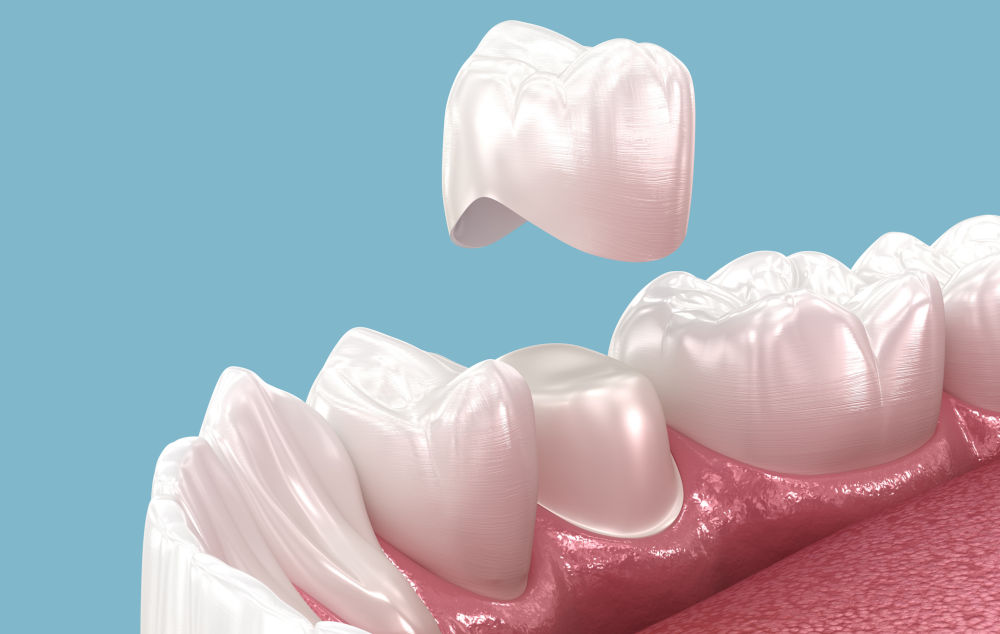
A dental crown is a custom-made cap that fits over an entire tooth, restoring its shape, size, strength, and appearance. The Canadian Dental Association describes a crown as a protective cover for a tooth that is damaged but not lost.
Full-mouth restoration (also called full-mouth reconstruction or full-mouth rehabilitation) takes this concept further. Instead of treating a single tooth, it involves placing crowns on most or all teeth across both the upper and lower jaws. The treatment is planned as a single coordinated case rather than a series of separate procedures.
The distinction matters because when multiple teeth are restored together, the dentist can redesign how the upper and lower teeth meet. This means the bite, tooth alignment, and overall proportions can all be improved simultaneously. A single crown repairs one tooth. A full mouth restoration rebuilds the entire foundation of your smile.
Full mouth crown cases are not purely cosmetic. In most situations, there is a functional reason behind the treatment. Teeth that have been worn down over decades, weakened by large fillings, or damaged by grinding no longer support a healthy bite. Crowns restore the vertical dimension (the height at which your jaws close together), protect weakened tooth structure, and distribute chewing forces evenly.
For patients considering this treatment, understanding the cost of a dental crown in Ontario is an important first step. The overall investment depends on how many teeth need crowns and which materials are selected.
Find our Dental Clinic Near You
Who Is a Candidate for Full Mouth Crowns?
Not every patient with dental concerns needs full mouth restoration. The treatment is typically recommended when problems are widespread and interconnected, meaning that fixing one or two teeth alone would not resolve the underlying issue.
Common clinical situations that may lead a dentist to recommend full mouth crowns include:
Severely worn teeth. Grinding (bruxism), clenching, and acid erosion gradually remove enamel and reduce tooth height. Over time, the bite collapses, the face may appear shorter, and the teeth look flat or uneven. Crowns rebuild the lost structure and restore proper bite height.
Multiple large or failing restorations. Teeth with old amalgam fillings, cracked composite restorations, or repeated repairs often lack enough healthy structure to support another filling. Crowns wrap around the entire tooth, providing full coverage protection.
Collapsed bite and loss of vertical dimension. When several teeth are worn, broken, or missing, the distance between the upper and lower jaws decreases. This can cause jaw pain, muscle fatigue, and accelerated wear on remaining teeth. Full mouth crowns allow the dentist to carefully re-establish the correct bite height.
Aesthetic and functional concerns combined. Some patients have teeth that are discoloured, uneven, or misshapen across the full arch. When the issues affect both appearance and chewing function, a full-mouth restoration addresses both in a single treatment plan.
There are situations in which full-mouth crowns may not be appropriate. Active gum disease must be treated before any crowns are placed, because crowns require healthy gum and bone tissue for long-term support. Patients with severe periodontal issues may need non-surgical gum therapy or other treatment before moving forward with restoration. If a tooth has too little structure remaining to hold a crown, a dental implant may be needed to replace it entirely.
Types of Dental Crown Materials Compared
Choosing the right crown material is one of the most important decisions in a full mouth restoration. Each material has distinct properties that make it better suited for certain teeth and situations. Your dentist will select materials based on tooth position, bite forces, and aesthetic requirements.
All-Ceramic (Porcelain) Crowns
All-ceramic crowns are made entirely of dental porcelain with no metal framework inside. The most widely used type is lithium disilicate glass ceramic, commonly known by the brand name IPS e.max. This material has a flexural strength of approximately 400 megapascals (MPa), which is strong enough for most teeth while offering excellent aesthetics.
What makes all-ceramic crowns stand out is their translucency. Natural tooth enamel allows some light to pass through rather than simply reflecting it off the surface. Porcelain crowns replicate this quality, which is why they can look virtually identical to natural teeth. The colour, texture, and light behaviour are matched to your existing teeth so the crown blends in seamlessly.
All-ceramic crowns are most commonly used for front teeth and teeth that are visible when you smile. Dental ceramists can layer different shades of porcelain to reproduce the subtle colour gradients found in natural teeth, from the slightly translucent biting edge to the more opaque base near the gum line.
Zirconia Crowns
Zirconia (zirconium dioxide) is a ceramic material known for exceptional strength. Monolithic zirconia crowns can have a flexural strength exceeding 1,000 MPa, making them significantly stronger than traditional porcelain. This strength makes zirconia the material of choice for back teeth (molars and premolars), where chewing forces are greatest.
Earlier generations of zirconia had a reputation for looking opaque and artificial. Modern multi-layered zirconia has addressed this issue by incorporating gradient translucency. The material transitions from a more opaque, stronger base to a more translucent, natural-looking surface. This means zirconia is now used for front teeth in many cases, particularly when a patient has a strong bite or history of grinding.
A 2026 systematic review and meta-analysis published in PubMed found that monolithic zirconia crowns achieve a 5-year survival rate of 96.8% , comparable to the 97.1% rate for metal-ceramic crowns. Monolithic designs also reduce the risk of chipping because there is no separate porcelain layer that can fracture.
In full mouth restoration cases, zirconia is frequently chosen for the posterior (back) teeth because it withstands heavy biting forces without fracturing. Many treatment plans combine zirconia in the back with lithium disilicate porcelain in the front, capturing the best properties of each material.
Porcelain-Fused-to-Metal (PFM) Crowns
PFM crowns have a metal substructure covered with a layer of tooth coloured porcelain. For decades, this was the standard in crown dentistry. PFM crowns offer good strength and reasonable aesthetics, with a well-documented clinical track record.
However, PFM crowns have limitations that modern all-ceramic options have largely overcome. The metal base can create a dark line along the gum margin, which becomes more visible if the gums recede over time. The porcelain layer can also chip away from the metal, requiring repair or replacement.
PFM crowns are still used in certain situations, particularly for long span bridges where the metal framework provides structural support. But for most full-mouth restoration cases today, all-ceramic and zirconia materials are preferred for their superior aesthetics and comparable durability.
How Dentists Choose the Right Material for Each Tooth
In a full-mouth restoration, the dentist does not necessarily use the same material for every crown. The decision is based on several factors for each individual tooth.
Position in the mouth. Front teeth (incisors and canines) are in the aesthetic zone and need to look as natural as possible. Back teeth (premolars and molars) are subjected to the highest chewing forces and need maximum strength.
Bite force and habits. Patients who grind or clench their teeth need more durable materials. Zirconia is often recommended for bruxism patients because it resists fracture under heavy loads.
Amount of remaining tooth structure. Some teeth may have minimal structure left after old fillings are removed. Zirconia's strength allows for slightly thinner crown preparations, preserving more natural tooth.
Opposing teeth. The material of the crown should be compatible with what it bites against. Overly hard materials that oppose natural enamel can accelerate wear on the natural tooth.
In the real patient case featured later in this article, 14 porcelain crowns were placed at Pickering Smile Centre: 8 on the upper jaw (maxillary) and 6 on the lower jaw (mandibular). The material choice across both arches created a unified, natural appearance while restoring full function.
Crowns on Front Teeth: What Patients Should Know
Front teeth present a unique challenge in restorative dentistry. These are the teeth that are most visible when you speak, smile, and laugh. Any restoration on a front tooth needs to look completely natural under all lighting conditions.
Why Front Teeth Require a Different Approach
Front teeth bear lower chewing forces than molars, but they are subjected to shearing forces when you bite into food. The material selected must be strong enough to resist these forces while delivering the highest possible aesthetic result.
Natural front teeth have complex optical properties. They are not a uniform colour. The biting edge is typically more translucent, sometimes with a slightly greyish or bluish tint. The middle of the tooth tends to be the brightest and most opaque. Near the gum line, the tooth takes on a warmer, more yellowish tone. Any crown placed on a front tooth must reproduce these gradients to avoid looking flat or artificial.
Shade Matching and Customization
Before fabricating front tooth crowns, the dentist performs detailed shade matching. This involves comparing the colour of your natural teeth against a standardized shade guide, often supplemented by digital shade analysis. For full mouth cases where all front teeth are being crowned, the shade is chosen to complement your skin tone, lip colour, and the amount of white that looks natural for your age and facial features.
The dental laboratory technician plays an essential role. Skilled ceramists hand-layer porcelain to build up the crown with internal colour variations that mimic real tooth structure. Some laboratories use digital photography with specialized colour charts so the technician can see exactly what the final result should look like.
Best Materials for Front Tooth Crowns
For front teeth, lithium disilicate (e.max) is widely considered the gold standard because of its excellent light transmission and natural appearance. In cases where extra strength is needed, multi-layered zirconia provides a good balance between aesthetics and durability.
The before-and-after photos in this article show the result of porcelain crowns on the upper front teeth. The 8 maxillary crowns in the patient's case represent the full aesthetic zone, the teeth that are visible when smiling. The transformation demonstrates how modern porcelain materials can create a result that looks like a natural, healthy set of teeth rather than artificial restorations.
The Full Mouth Crown Procedure Step by Step
Understanding what happens at each stage of the process helps patients feel prepared and reduces anxiety. A full mouth crown restoration involves several appointments spread over weeks or months, depending on the complexity of the case.
Consultation, Imaging, and Treatment Planning
The process begins with a comprehensive examination. The dentist evaluates the condition of every tooth, the health of the gums and bone, and the way your upper and lower teeth come together (your occlusion).
Diagnostic records typically include digital X-rays and, in complex cases, a CBCT (cone beam computed tomography) scan that provides a three-dimensional image of the teeth, bone, and jaw joints. Digital impressions or traditional dental moulds are taken to create study models.
The dentist uses these records to develop a detailed treatment plan. This may include a diagnostic wax-up, a physical model that shows what the final result will look like, or a digital smile design created with specialized software. Some teeth may need preliminary treatment before crowns can be placed. For example, a tooth with deep decay may require a root canal first. Teeth with active infection must be treated. Gum tissue must be healthy.
Treatment planning for a full-mouth case is more complex than for a single crown because the dentist must design how all the teeth will fit together. The shape, size, and position of each crown affect the bite, jaw movement, and overall facial appearance.
Tooth Preparation and Temporary Crowns
Once the treatment plan is finalized, the preparation phase begins. The dentist numbs the teeth with local anesthesia and reshapes each tooth by removing a thin layer of enamel (typically 1 to 2 millimetres) to create space for the crown.
In a full mouth case, tooth preparation may be done in stages. For example, the upper teeth might be prepared at one appointment and the lower teeth at the next. This allows the patient to maintain some normal function between visits.
After the teeth are prepared, digital scans or impressions are sent to the dental laboratory. Meanwhile, temporary (provisional) crowns are placed over the prepared teeth. Temporaries serve several important purposes: they protect the prepared teeth, maintain tooth position, allow you to eat and speak normally, and give you a preview of the final result.
In complex cases, the patient may wear provisional crowns for several weeks so the dentist can evaluate how the new bite height and tooth shape work in daily life. Adjustments can be made to the temporaries before the final crowns are fabricated.
Lab Fabrication
The dental laboratory receives detailed instructions from the dentist, including the digital scans, shade information, and notes about the desired shape and contour of each crown.
Modern labs use CAD/CAM (computer-aided design and manufacturing) technology to mill or press the crowns from ceramic blocks. For high-aesthetic cases, a ceramist may add hand-layered porcelain to create the colour depth and surface texture that mimic natural teeth.
Fabrication typically takes one to three weeks, depending on the laboratory and the complexity of the case. Some practices have in-office milling equipment that can produce certain types of crowns in a single visit, though full mouth cases generally benefit from the precision of a dedicated laboratory.
Final Placement and Bite Adjustment
When the crowns are ready, the patient returns for the fitting appointment. The dentist removes the temporary crowns and tries in the permanent ones, checking the fit, colour, and shape of each crown.
Once everything looks correct, the crowns are bonded to the prepared teeth using dental cement. The dentist then checks the bite carefully, using articulating paper (a thin coloured strip that marks where the teeth contact) to ensure even contact across all teeth. Minor adjustments are made by polishing specific areas of the crowns.
The final result is a full set of crowns that look natural, fit comfortably, and function properly.
Timeline: How Many Appointments Does Full Mouth Restoration Take?
The total number of appointments varies based on the case's complexity and whether any preliminary treatments (such as root canals or gum therapy) are needed. A typical full mouth restoration timeline looks like this:
Initial consultation and treatment planning: 1-2 appointments. Preliminary treatments (if needed): varies. Tooth preparation and temporary crowns: 2 to 4 appointments (staged by arch or quadrant). Final crown placement: 1-3 appointments.
From start to finish, most full mouth restorations are completed within 2 to 6 months. More complex cases that require gum treatment, implants, or orthodontic work may take longer.
Before and After: A Real Patient Case from Pickering Smile Centre
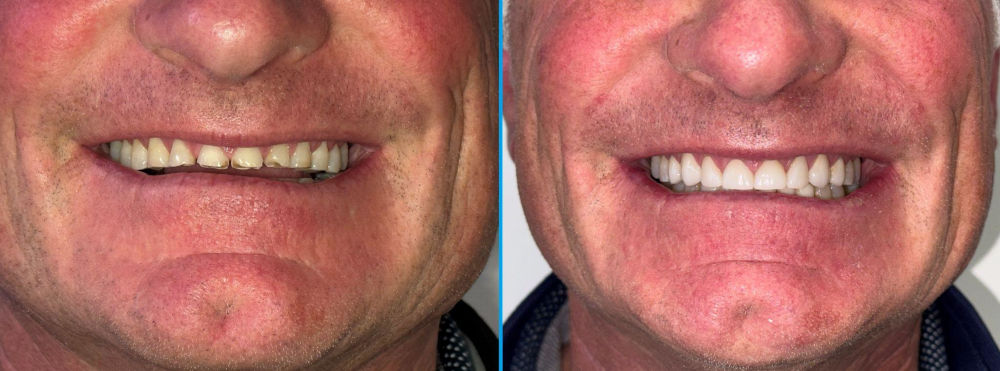
This patient received a complete smile restoration with 14 porcelain crowns at Pickering Smile Centre. The treatment included 8 crowns on the upper jaw (maxillary arch) and 6 on the lower jaw (mandibular arch).
The before photo shows teeth that had become worn, discoloured, and uneven over time. Several teeth had visible chips, dark staining between and along the gum line, and gaps that affected the overall appearance of the smile. The tooth surfaces appeared flattened from years of use, and the teeth's natural shape and proportions had been lost.
The after photo shows the result following placement of all 14 porcelain crowns. The teeth now have a consistent, natural colour. The shape and proportions of each tooth have been carefully designed so that the central incisors are the most prominent, with the lateral incisors and canines tapering naturally to the sides. The gum line appears even and healthy, and the teeth have a smooth, polished surface with a natural-looking texture.
What makes this case particularly notable is that the restoration was accomplished entirely with porcelain crowns, without the need for dental implants or extractions. The patient's existing teeth provided a solid foundation, and the crowns restored both the appearance and the structural integrity of the entire smile.
This type of transformation is representative of what full mouth porcelain crown restoration can achieve when the underlying teeth are still viable. The treatment combines the precision of modern materials with detailed treatment planning to deliver a result that looks natural while functioning properly for years to come.
How Long Do Porcelain Crowns Last? Lifespan and What Affects It
One of the most common questions patients ask before committing to full mouth restoration is how long the crowns will last. The answer depends on the material, the quality of the work, and how well the crowns are maintained.
Expected Lifespan by Material
Research provides clear data on crown survival rates. A large-scale systematic review published in 2026 analyzed data from 64 clinical studies covering more than 11,500 crowns. The five-year survival rates were as follows:
Monolithic lithium disilicate (e.max): 98.5%. Veneered zirconia: 97.3%. Metal-ceramic (PFM): 97.1%. Monolithic zirconia: 96.8%.
In practice, well-maintained porcelain crowns routinely last 10 to 15 years, and many last 20 years or longer. Zirconia crowns, due to their superior strength, have the potential for even longer service life, though long-term data (beyond 15 years) are still accumulating, as the material is relatively new in widespread clinical use.
Cleveland Clinic notes that crowns generally last between 5 and 15 years with proper care, though this range accounts for all material types and maintenance levels.
Factors That Shorten Crown Lifespan
Bruxism (teeth grinding and clenching). Grinding places excessive force on crowns, particularly on the biting surfaces. Over time, this can cause chips, cracks, or loosening. Patients who grind should wear a custom night guard to protect their investment.
Poor oral hygiene. A crown itself cannot decay, but the natural tooth underneath it can. If bacteria accumulate along the crown margin (the edge where the crown meets the tooth), decay can develop underneath, eventually causing the crown to fail. This is why daily brushing and flossing remain essential even with full mouth crowns.
Diet and habits. Regularly chewing ice or hard candies, or using teeth to open packaging, puts unnecessary stress on crowns. Acidic foods and beverages can also affect the cement that holds the crown in place.
Smoking. Tobacco use contributes to gum disease, which can cause gum tissue to recede, exposing the crown margin. This both compromises the seal and affects the appearance.
Factors That Extend Crown Lifespan
Custom night guard. For patients with a history of grinding, a night guard is one of the most effective ways to protect full-mouth crowns.
Regular dental visits. Professional cleanings and examinations allow the dentist to spot early signs of problems, such as a loosening crown, cement washout, or early decay at the margin, before they become major issues. A dental check-up every six months is recommended.
Proper oral care at home. Brushing twice daily with a soft-bristled toothbrush, flossing around each crown, and using an antiseptic rinse keeps the margins clean and the gum tissue healthy.
Quality of the initial placement. The precision of the crown fit, the quality of the laboratory work, and the cementation protocol all influence long-term success. A well-fitting crown with minimal gap at the margin is far more resistant to decay and loosening than a crown with poor marginal adaptation.
When Does a Crown Need Replacement?
Even the best crown will eventually need attention. Signs that a crown may need replacement include visible chips or cracks in the porcelain, a crown that feels loose or rocks when you press on it, pain or sensitivity around a crowned tooth (which may indicate decay underneath), and visible recession exposing a dark margin at the gum line.
If you notice any of these signs, schedule an appointment promptly. Early intervention can sometimes save the underlying tooth and simplify the replacement process.
Recovery and Aftercare After Full Mouth Crowns
The recovery period after full-mouth crown placement is generally straightforward, but knowing what to expect helps patients manage the transition more comfortably.
The First Few Days
Mild sensitivity to hot and cold temperatures is normal in the days following crown placement. This typically resolves within one to two weeks as the teeth adjust. Some patients also notice a slight difference in their bite, which usually settles as the muscles and jaw adapt to the new crown contours.
If any individual crown feels noticeably high (meaning it contacts before the other teeth when you close your bite), contact your dentist for a quick adjustment. An uneven bite can cause discomfort and place excessive stress on specific crowns.
What Is Normal vs. When to Call Your Dentist
Normal: mild sensitivity, slight bite adjustment period, minor gum tenderness around crown margins. Call your dentist if you have sharp or persistent pain, a crown that feels loose or movable, a crack or chip in any crown, or swelling or signs of infection.
Long-Term Care
Caring for full mouth crowns is similar to caring for natural teeth, with a few additional considerations.
Brush twice daily using a soft-bristled toothbrush and fluoride toothpaste. Hard-bristled brushes can scratch the surface of porcelain over time.
Floss daily, making sure to slide the floss down to the gum line around each crown. Some patients find that a water flosser is helpful for cleaning around crown margins.
If you grind your teeth, wear a custom night guard every night. This is especially important for patients with full mouth crowns, as grinding can damage multiple crowns simultaneously.
Attend dental cleaning appointments every six months. Professional cleanings remove calculus (hardened plaque) that brushing alone cannot eliminate, particularly along the crown margins where bacteria tend to accumulate.
Avoid biting hard objects such as ice, pen caps, hard candies, and nutshells. While modern crown materials are strong, they are not indestructible, and a sudden impact can cause a fracture.
Full Mouth Crowns vs. Other Restoration Options
Full mouth crowns are one of several options for restoring a damaged smile. Understanding the alternatives helps patients and dentists choose the approach that best fits the clinical situation.
Crowns vs. Porcelain Veneers
Porcelain veneers are thin shells bonded to the front surface of teeth. They require less tooth reduction than crowns (typically 0.3 to 0.7 mm vs. 1 to 2 mm for crowns) and are an excellent option when teeth are structurally sound but need cosmetic improvement.
However, veneers only cover the front surface. If a tooth is weakened, heavily filled, or cracked, a veneer does not provide the full protection that a crown does. For patients with significant structural damage across multiple teeth, crowns are the more appropriate choice.
For patients whose concerns are primarily cosmetic and whose teeth are otherwise healthy, learning about veneer costs in Pickering can help with the comparison.
Crowns vs. All-on-X Dental Implants
All-on-X dental implants are designed for patients who have already lost most or all of their teeth, or whose remaining teeth are beyond saving. The procedure involves placing four to six implants in each jaw and attaching a full arch prosthesis.
Full mouth crowns, by contrast, preserve the patient's natural teeth. As long as the existing teeth have adequate structure and healthy roots, crowns are generally preferred because natural teeth provide better sensory feedback (proprioception) and do not require surgical implant placement.
The choice between the two depends on the condition of the remaining teeth. When teeth can be saved, crowns are the less invasive option. When they cannot, All-on-X provides a comprehensive solution.
Crowns vs. Dental Bridges
A dental bridge replaces one or more missing teeth by anchoring artificial teeth to the crowns on either side of the gap. In a full mouth restoration, bridges and crowns may be used together: crowns protect damaged teeth, and bridges fill in where teeth are missing.
The key difference is that bridges require preparing the adjacent teeth to serve as anchors, even if those teeth are healthy. When a single tooth is missing, and the neighbouring teeth are strong, a dental implant may be a better option than a bridge because it does not require modifying adjacent teeth.
Crowns vs. Fillings
For a single tooth with moderate decay, a filling may be sufficient. But when more than half of the tooth's surface has been damaged, or the tooth has been previously filled multiple times, a crown provides superior protection. A filling replaces lost tooth structure within the tooth. A crown wraps around the outside, holding everything together and preventing fracture.
What Full Mouth Restoration Actually Changes
Full mouth restoration is not a cosmetic upgrade. It is a structural reset: bite height rebuilt, force redistributed across every tooth, years of accumulated damage replaced with materials engineered to outlast the fillings that failed before them. Modern zirconia and lithium disilicate crowns achieve five-year survival rates above 96%, and monolithic designs have reduced the chipping problem that limited earlier ceramic generations.
The decision involves multiple appointments, careful material selection, and patience during recovery. But for patients whose teeth have passed the point where isolated repairs hold, full mouth crowns are the procedure that makes everything work together again. One coordinated plan instead of a decade of patchwork.
Frequently Asked Questions
How painful is a full mouth crown procedure?
The procedure is performed under local anesthesia, so you should not feel pain during the appointment. You will feel pressure and vibration as the dentist reshapes the teeth, but the anesthesia prevents sharp pain. After the anesthesia wears off, mild soreness and sensitivity are common for a few days. Most patients manage any discomfort with over-the-counter pain medication.
Can you get crowns on all your teeth?
Yes, it is possible and not uncommon. Full-mouth restoration cases often involve crowning most or all of the teeth in both arches. The patient case in this article involved 14 crowns placed across both jaws. Whether all teeth need crowns depends on the clinical assessment; some teeth may only need smaller restorations.
How long does a full mouth restoration take from start to finish?
Most cases are completed within 2 to 6 months. The timeline depends on whether preliminary treatments (root canals, gum therapy, extractions) are needed, the number of crowns being placed, and the fabrication time at the dental laboratory. Complex cases that include implants or orthodontic alignment may take longer.
Is a dental crown the same as a veneer?
No. A crown covers the entire tooth, including the front, back, and chewing surface. A veneer covers only the front surface. Crowns are used when a tooth needs structural reinforcement. Veneers are used primarily for cosmetic improvement on teeth that are otherwise healthy and strong.
Can a tooth decay under a crown?
Yes. The crown protects the visible portion of the tooth, but the natural tooth structure underneath remains vulnerable to bacteria. If plaque accumulates along the margin where the crown meets the tooth, decay can develop at that junction. This is why daily brushing and flossing around crowns is essential.
Do you always need a root canal before getting a crown?
No. A root canal is only needed if the nerve (pulp) inside the tooth is infected or damaged. Many teeth receive crowns without any root canal treatment. However, in a full-mouth restoration, some teeth with extensive decay near the nerve may require root canal therapy as part of the preparation process.
Are dental crowns covered by insurance in Ontario?
Most dental insurance plans in Ontario classify crowns as a "major" restorative procedure and provide partial coverage, typically between 50% and 80% of the cost. Coverage varies by plan, and there may be annual maximums that limit the total benefit. Some plans also require pre-authorization before crown treatment begins. Patients enrolled in the Canadian Dental Care Plan (CDCP) may also have coverage for crowns, though pre-authorization through Health Canada is required. Checking with your insurance provider before starting treatment is always recommended.